


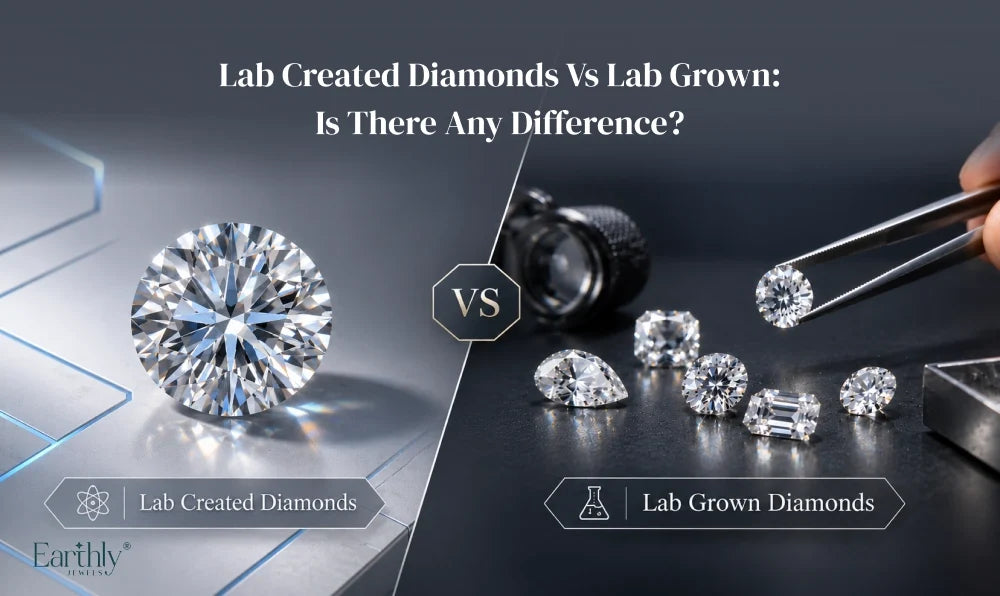
Type lab created diamonds into a search bar, and lab grown pops up right next to it. It's natural to wonder if you're looking at two different products. Here's the good news: the answer is short and easy. This guide shows where the names differ, where they match, and what to check before you pay.
Both names describe a diamond made in a controlled setting instead of a mine. The finished diamond has nearly the same carbon crystal as a mined one. Shops pick one phrase over the other out of habit, style, or local rules. So the label changes, but the diamond stays the same.
There is one catch, and it's worth knowing early. Some sellers stretch the word created to cover look-alikes such as cubic zirconia. Those aren't diamonds, so the exact wording on a tag really matters. Later, we'll also look at lab created diamond rings, necklaces, bracelets, and everyday studs.
Two Tags, One Diamond
Picture two rings in two different shops. One tag says lab grown diamonds, and the other says lab created. The diamonds can be twins, with the same carbon crystal and the same sparkle. Only the name tag changed, so the real question is the wording.
The two phrases come from trade habits, not from two different products. Some brands like lab grown because it hints at how the diamond forms. Others like lab created because it sounds plain and familiar. You'll often spot both terms side by side on a single page.
What the FTC Says About the Words
In the US, the Federal Trade Commission accepts both lab grown and lab created as clear labels. It also accepts a maker's name followed by the word created. The FTC says the bare word diamond still points to a mined one. That's why a clear label like lab created diamonds helps buyers and sellers alike.
Words You Will See on Product Pages
Shops use a handful of labels when they sell lab created diamonds. Most of them mean exactly the same thing. A few just sound longer or more formal. Here's a quick way to read each one.
- Lab grown: the diamond was grown in a controlled setting, not mined.
- Lab created: the same meaning, said a little differently.
- Brand-created: a maker's own name followed by the word created.
- Man made: a plain phrase many shoppers use for the same diamond.
Lab Created Diamonds vs Lab Grown at a Glance
A side-by-side view makes the answer easy to see. The first two columns describe one diamond under two names. The third column shows what can go wrong with loose wording. Keep this table handy while you shop.
| Point | Lab grown diamond | Lab created diamond | Look-alike sold as "lab created" |
| What it is | A diamond grown in a controlled setting | The same diamond, worded differently | A different material, not a diamond |
| Material | Carbon | Carbon | Often cubic zirconia or similar |
| Hardness | 10 on the Mohs scale | 10 on the Mohs scale | Lower than diamond |
| Sparkle | Diamond brilliance | Diamond brilliance | Different light behaviour |
| Wording | Lab grown | Lab created | Should say imitation or simulated |
When the Word Created Can Mislead
Created is a stretchy word, and some sellers use it loosely. Cubic zirconia can be made in a factory, yet it isn't a diamond. The FTC says such look-alikes should be called imitation or simulated. A quick check keeps you from paying a diamond price for another material.
Questions to Ask Before You Pay
Before buying lab created diamonds, a few clear answers can save you a lot of worry. Ask these questions in store, on a call, or by chat. Good sellers will answer without any fuss. Keep the replies for your records.
- Does the centre stone have the same composition as a naturally mined diamond?
- Does the invoice place lab grown or lab created before the word diamond?
- Is a grading report included, and does it name the origin?
- Is the size given in carat weight, not just millimetres?
- Does the return policy cover the piece in writing?
A Simple Wording Test
Read the product title out loud, with the word diamond included. A line such as lab created diamonds in 18k gold passes the test. A phrase such as created crystal or lab sparkle does not. If the title hides the material, ask before you buy.
How Lab Created Diamonds Perform in Daily Wear
Both terms describe the same material. Diamonds score 10 on the Mohs hardness scale, regardless of their origin. Lab created diamond rings, bracelets, and studs suit everyday wear when crafted securely. The metal quality and setting design are equally important for lasting durability.
- Same: hardness, sparkle, and crystal pattern.
- Same: the range of shapes, from round to pear to emerald.
- Can differ: price for a similar size and quality.
- Can differ: the report format and the words used on it.
Lab Created Diamond Rings for Every Style
Rings are usually where shoppers first meet this choice. Lab created diamond rings come in solitaire, halo, three-diamond rings, and many other designs. The label never limits the setting, the metal, or the shape. Here's how two popular ring groups compare.
Lab Created Diamond Engagement Rings
Lab created diamond engagement rings follow the same style rules as any other engagement ring. A solitaire keeps all eyes on one diamond, while a hidden halo adds a quiet extra glow. The Earthly Jewels solitaire rings collection lets you filter by round, oval, pear, cushion, and more. For lab created diamond engagement rings, browsing shapes side by side is the fastest way to learn your taste.
Shapes That Suit Different Hands
Each shape changes how lab created diamond rings sit and look on the finger. Trying a few lab created diamond engagement rings in person or on screen helps you decide. Here are four popular outlines. Pick the one that feels like you.
- Round: the classic outline with lively, even sparkle.
- Oval: an elongated outline that suits a longer, slimmer look.
- Pear: a teardrop outline with one soft point.
- Emerald: long step cuts that give a clear, mirror-like look.
Lab Created Diamond Band Styles
A lab created diamond band can be plain, pave, twisted, or set all the way around. The same band styles work for lab created diamond rings, whether a shop says lab grown or lab created. Pairing a slim band with a solitaire keeps the centre diamond in focus. A lab created diamond band with side accents adds more sparkle to the finger.
- Plain band: simple, smooth, and easy to stack.
- Pave band: tiny diamonds set along the shank for added shine.
- Twisted shank: two strands that wind around the centre diamond.
- Eternity band: diamonds set around the full ring.
Everyday Lab Created Diamond Jewellery Beyond Rings
Lab created diamond rings get the attention, but daily wear often starts with smaller pieces. The same naming rules apply to all lab created diamonds, so check each label. Here are three easy choices. They suit work, travel, and weekends.
Lab Created Diamond Necklace Styles
A lab created diamond necklace works as a quiet daily layer or a bold focal point. Solitaire pendants stay simple, while a line of diamonds feels dressier. Shorter chains sit near the collarbone, and longer ones suit open necklines. A lab created diamond necklace is also a meaningful choice for celebrating birthdays and anniversaries.
Tennis Bracelet Lab Created Diamond Picks
A tennis bracelet lab created diamond style uses one smooth line of matched diamonds. The clasp should feel secure, and the links should move freely. A lab created diamond tennis bracelet looks great with a watch or on its own. With any tennis bracelet lab created diamond style, check the length against your wrist first.
Lab Created Diamond Studs for Daily Wear
Lab created diamond studs are the easiest way to wear a diamond every day. Small sizes feel light, while larger ones make a stronger statement. Screw-back or push-back fittings keep them secure through a busy day. Choose matching shapes, such as two rounds or two princess cuts, for a balanced pair.
Key Takeaways
- Same: Lab grown and lab created describe the same kind of diamond made in a controlled setting.
- Words: The FTC accepts both lab grown and lab created as clear labels for these diamonds.
- Caution: Look-alikes such as cubic zirconia can be called created, so read the full title.
- Material: Make sure the centre material is a diamond before you pay.
- Hardness: Both labels share the same hardness of 10 on the Mohs scale.
- Rings: Lab created diamond engagement rings suit solitaire, halo, and three-diamond styles.
- Bands: A lab created diamond band can be plain, pave, twisted, or eternity style.
- Necklaces: A lab created diamond necklace adds easy sparkle to daily outfits.
- Bracelets: A lab created diamond tennis bracelet gives one smooth line of sparkle.
- Studs: Lab created diamond studs make an easy first piece for daily wear.
Conclusion
Lab created diamonds and lab grown diamonds are one product with two names. The difference lives in the wording, not in hardness, sparkle, or structure. The only real risk comes from loose labels that blur diamonds with look-alikes. A clear invoice and a grading report take that risk away.
Once the name is settled, the fun part begins. Pick a ring, a lab created diamond tennis bracelet, a necklace, or studs that fit your routine. Choose the style you'll actually enjoy wearing each day. Lab created diamonds then become a simple, confident choice for everyday jewellery.
Frequently Asked Questions
These answers cover the questions shoppers ask most often. Each one is short and direct. Use them as a quick checklist. The sections above have more detail.
Are lab created diamonds and lab grown diamonds the same thing?
Yes, both phrases describe a diamond grown in a controlled setting. The difference is in the wording, not the material. Just check that the label sits right beside the word diamond.
Do lab created diamonds share the same properties as mined diamonds?
Yes, they share essentially the same chemistry, crystal pattern, and hardness. Special equipment can sometimes tell them apart, but a casual look usually can't. A grading report is the dependable proof of origin.
Is cubic zirconia the same as a lab created diamond?
No, cubic zirconia is a different material with different hardness and sparkle. It should be sold as imitation or simulated. Ask for the material name in writing.
Which label is better on a product page?
Neither one is better, since both are accepted ways to describe the same diamond. Clarity matters more than the exact word. Look for the label right beside the word diamond.
Are lab created diamond engagement rings a good choice for a proposal?
Yes, they come in the same shapes and settings as any other engagement ring. Lab created diamond engagement rings also suit daily habits, so check the report first. A comfortable fit matters as much as the design.
Does a lab created diamond band look different from other diamond bands?
Not to the eye, since the diamonds share the same look. Any lab created diamond band differs only by metal, setting, and cut. Compare each lab created diamond band in person or by video before buying.
What should I check on a tennis bracelet lab created diamond style?
Look for matched diamonds, a secure clasp, and a length that suits your wrist. A good fit stops the bracelet from sliding or pinching. Ask whether a lab created diamond tennis bracelet comes with a report.
Are lab created diamond studs suitable for daily wear?
Yes, they're a light and easy choice for every day. Choose secure backs and a size you feel comfortable in. Matching shapes keep the pair balanced.


Share:
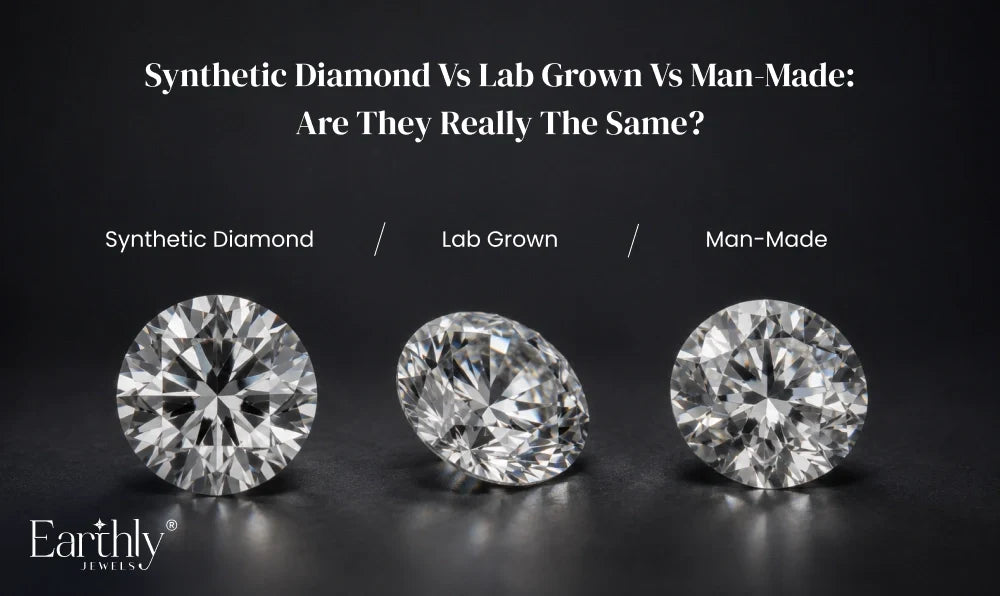
Synthetic Diamond vs Lab Grown vs Man-Made: Are They Really the Same?